Harbor House Adaptive Reuse | Historic YMCA Conversion & Tax Credit Preservation - Omgivning
Project Role: Job Captain
Shahrzad Razi served as the Job Captain on this adaptive reuse project, overseeing it from concept through permitting. Originally built in 1925–26 as the Army & Navy YMCA in a Mediterranean Revival style by Jay, Rogers & Stevenson, the five-story structure once housed a gym, swimming pool, 410-bed dormitory, handball courts, lounges and more. Over time, the building transitioned to civilian use, later operating as Harbor View House, a residential facility serving vulnerable populations. Under its rebirth, the design balances history and modernity: the soft pink tones, bold black and grey accents, and interplay of textures beautifully echo the building’s original elegance while asserting a refined, contemporary voice. The blush of the restored stone surfaces contrasts with darker architectural elements, giving the space a fresh yet respectful transformation.
Urban Revitalization. A bird's-eye view of the Harbor House transformation. We successfully converted this former YMCA institutional building into a vibrant multifamily community. The design prioritized the preservation of the historic red clay tile roof and the original building massing, ensuring compliance with Historic Tax Credit (HTC) requirements while reactivating the city block.
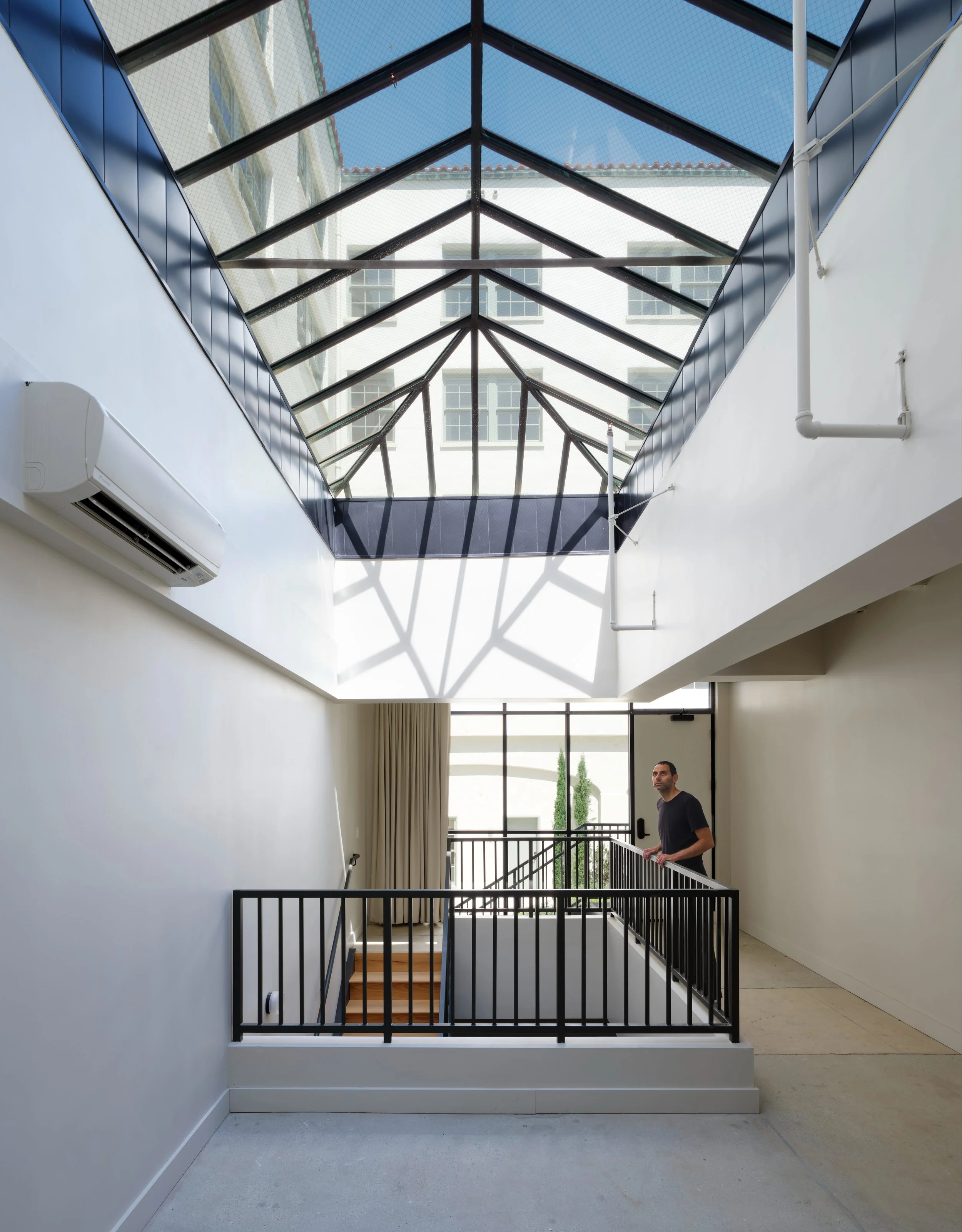
Bringing Light to the Core. Deep floor plates in historic buildings often struggle with natural light. We restored the original steel-truss skylight system to flood the central atrium with daylight. This acts as the social heart of the building, where we juxtaposed the historic structural shell with modern, minimal guardrail detailing to meet current building codes without disrupting the historic character.
Carving Out Community Space. We transformed the original utility areas into a lush, modern courtyard. The design features architectural steel staircases that provide exterior circulation, reducing the load on interior corridors. The stark white stucco contrasts with the historic masonry, creating a clean, modern amenity space that appeals to today's renters.
Scaffolding on historic facade during window restoration and exterior waterproofing.Envelope Restoration. Adaptive reuse requires rigorous waterproofing. This view shows the facade rehabilitation phase, including the installation of high-performance weather barriers and the restoration of historic window openings. We coordinated closely with preservation consultants to ensure the exterior treatments met the Secretary of the Interior’s Standards for Rehabilitation.
Structural Coordination. Converting a gym/institutional building into housing requires complex spatial division. Here, light gauge metal framing defines the new residential corridor. You can see the coordination required to route modern MEP (Mechanical, Electrical, Plumbing) systems through the existing concrete beam structure, maximizing ceiling heights while hiding utility runs.