

A Homeowner’s Guide to the Pasadena Hillside Overlay District
If you own property in the hills of Pasadena, you possess one of the most coveted assets in Southern California: a view. However, that view comes with a complex set of responsibilities.
The Hillside Overlay District (HOD) is a set of zoning regulations designed to preserve the character, safety, and natural beauty of Pasadena’s hillside neighborhoods. For homeowners looking to build, remodel, or expand, understanding these rules is not just a formality—it is the difference between a successful project and a stalled permit application.
As architects, we see the HOD not as a roadblock, but as a design framework. Here is what you need to know to navigate it successfully.
1. The Hillside Development Permit (HDP)
Most significant projects in the hillside zones (such as RS-1-HD or RS-2-HD) will trigger the need for a Hillside Development Permit. This is a discretionary permit, meaning it is not automatically granted. It often requires a public hearing and review by a Hearing Officer to ensure your project respects the terrain and your neighbors.
You will likely need an HDP if:
You are proposing a subdivision.
You are building a new house.
You are adding 500 square feet or more to the first floor of an existing structure.
Your project involves significant grading or slopes greater than 15%.
2. The Math of the Slope: Floor Area Ratios (FAR)
In the flatlands, your allowable square footage is a simple calculation based on lot size. In the hills, the slope dictates the size.
Pasadena uses a specific formula to reduce the allowable Floor Area Ratio (FAR) as the average slope of your lot increases. Simply put: the steeper your lot, the smaller the house you are allowed to build.
Note: Any portion of your lot with a slope of 50% or greater is generally deducted from the "buildable area" calculation entirely, significantly reducing your allowable square footage.
3. Neighborhood Compatibility: The "500-Foot Rule"
Pasadena places a high premium on neighborhood character. Your design is not judged in a vacuum; it is judged against your neighbors.
New additions or builds are often subject to a Neighborhood Compatibility analysis. The city reviews the median floor area of all homes within a 500-foot radius of your property. Generally, your allowable floor area cannot exceed 35% above that neighborhood median. This prevents "mansionization" and ensures your home scales appropriately with the street.
4. Height Limits and Ridgelines
Height in the HOD is measured differently than in flat zones. It is not just about how tall the building is; it is about how it sits on the land.
The Envelope: Structures usually cannot exceed 28 feet at any single point from the existing grade, with an overall maximum height of 35 feet from the lowest point of contact to the highest roof peak.
Ridgeline Protection: If your lot is near a recognized ridgeline, there are strict protections to prevent silhouettes that break the natural skyline.
5. View Protection
Perhaps the most subjective but critical element is view preservation. The city does not guarantee you a view, but it does protect against unreasonable blockage of existing views from neighboring properties. Your design must demonstrate sensitivity to the downhill and uphill neighbors' sightlines.
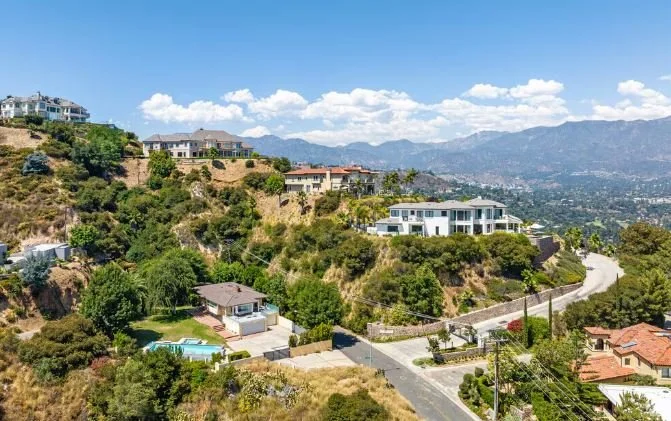
Pasadena Hillside New Construction Residence
Project Kickoff Checklist: Preparing for the Hillside
Before scheduling your initial consultation, gathering the following documents will allow us to give you much more concrete feedback on your property’s potential.
1. A Recent Topographic Survey In the Hillside Overlay, a standard boundary survey isn't enough. We need a survey that maps the contours (elevation changes) of the land.
Why it matters: This determines your "average slope," which dictates your allowable square footage.
2. Property Profile & APN Locate your Assessor’s Parcel Number (APN).
Why it matters: This allows us to look up your specific zoning designation (e.g., RS-4-HD vs. RS-6-HD) and pull the exact setbacks and constraints for your lot.
3. Title Report (Preliminary)
Why it matters: Hillside lots are often crisscrossed with utility easements, drainage easements, or shared driveway agreements that can strictly limit where you can build.
4. Existing "As-Built" Blueprints If you are remodeling, try to find the original plans for the house.
Why it matters: Knowing the existing structural logic saves time and money during the design phase. You can often find these in the City of Pasadena’s records department if you don’t have copies.
5. Geotechnical (Soils) Report
Why it matters: If you have a report from a previous project, it is very helpful. If not, be prepared that commissioning a new soils report is often the very first required step for any hillside engineering.
6. Your "Must-Haves" vs. "Nice-to-Haves" Create a simple list of your goals. Do you need a new primary suite, or just a refreshed layout? Are you looking to maximize views, or maximize privacy?
Building in the Hills Requires a Guide. Whether you are planning a second-story addition or a ground-up estate, you need a team that speaks the language of the City of Pasadena.
